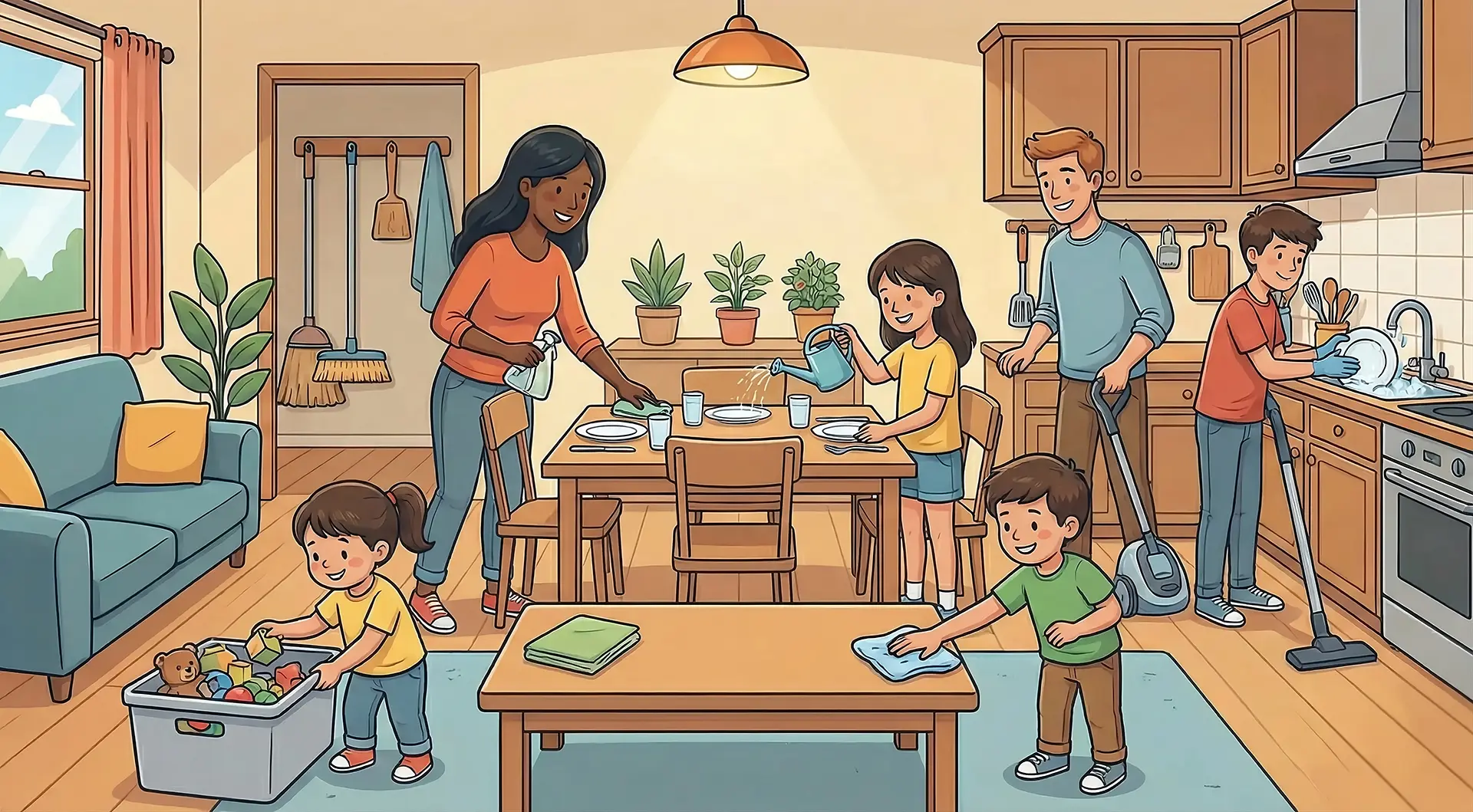
Why a chore schedule changes everything
In most households, cleaning doesn't lack hands, it lacks a system. Nobody knows who should do what or when, so everything rests on the person who "keeps track", and keeping track of everything, reminding, checking, is exactly the mental load that wears people out. The result: the windows wait for months, the litter box overflows, and the same person always ends up doing it with a sigh.
A chore schedule fixes the problem at the root: every recurring task has a rhythm, a due date and, if you want, an owner. No more keeping it all in your head, the schedule remembers for you. Wash the windows every 2 weeks, change the sheets weekly, clean the fridge once a month: it's written down, you get reminded, it gets done.
Everyone benefits from this framework: the person who carried the mental load (they finally get to put it down), and everyone else (no more vague "you never do anything", just clear expectations with dates on them).
Paper, fridge, spreadsheet: why classic chore charts die within two weeks
You've probably tried it already: the magnetic board on the fridge, the printed sheet, the shared spreadsheet. These schedules start with good intentions, but they have three fatal flaws:
- They never remind you. A chart will never tell you that today is window day. It sits there, passive, waiting to be looked at, and people quickly stop looking.
- They don't measure fairness. The chart says who does what, but not how much each task weighs. Taking out the trash and scrubbing the bathroom each count as "one tick"? Nobody's fooled, and the frustration comes back.
- Nobody keeps them up to date. One week of vacation, one hiccup, and the paper schedule is obsolete. Updating it is one more chore… that lands on the same person.
It's not a motivation problem: it's a tool problem. A good schedule has to remind, measure and adapt all by itself.
How the FairChore schedule works
FairChore includes a schedule built for real households, families, couples, roommates. The principle fits in three simple steps:
- Schedule at your own pace. One time only, every day, every 2 weeks, every month: recurrence is fully flexible (by days, weeks or months, with any interval you like). You set the first due date and the schedule keeps going on its own.
- Choose who's involved. A task can be assigned to a specific member ("the trash is Leo's job") or left open to the whole household, the first one to do it checks it off. You can also build a schedule just for yourself.
- When the day comes, one tap is enough. Today's tasks and overdue ones show up on the dashboard, and everyone gets a reminder (notification or email) on the due date. Tap "Done", the points are distributed, and the next due date is already set.
Something comes up? Skip an occurrence in one tap, and the rhythm picks up again next cycle. The schedule adapts to life, not the other way around.
The real difference: a schedule that measures fairness
This is what sets FairChore apart from a plain chore calendar: here, every task is worth points, matching how unpleasant it really is. When someone completes a scheduled task, they earn points and the other members involved lose some, the household total always stays at zero.
In practice, your schedule no longer just says "who does what": it shows, week after week, who really carries the household. Balance is no longer a feeling you argue about, it's a number everyone can see. And if a chore never finds a taker, just raise its points to make it attractive: fairness regulates itself, without painful negotiations.
What does a good household schedule look like?
Every household has its own rhythm, but here's a starting base that works:
- Every day: dishes or dishwasher, clearing the table, litter box or pet bowls.
- Every week: vacuuming, sheets, bathroom, groceries, trash and recycling.
- Every 2 weeks: washing the windows, deep dusting, caring for demanding plants.
- Every month: cleaning the fridge, oven or microwave, sorting paperwork, descaling the kettle.
Start small, five or six recurring tasks are enough. A schedule that's too ambitious on day one is the surest way to abandon it. You'll expand it naturally once the rhythm settles in.
Housework… and beyond: schedule everything that repeats
A household doesn't run on sponges and vacuum cleaners alone. Everything that comes back regularly deserves its place in the schedule:
- Living things: watering the plants every 2 days, walking the dog, vet appointments.
- Paperwork: paying the bills, checking the mail, reviewing subscriptions every month.
- The kids: packing the sports bag every Tuesday, checking homework, tidying the bedroom on Saturday.
- Maintenance: testing the smoke detector, changing the range hood filter, bleeding the radiators in the fall.
With FairChore's customizable categories and task types, your schedule fits your household's reality, not some printable template found online.
Ready to give your household a rhythm? Create your group, schedule your first three recurring tasks and let the reminders do the rest. It's free, and it lasts longer than two weeks, promise.