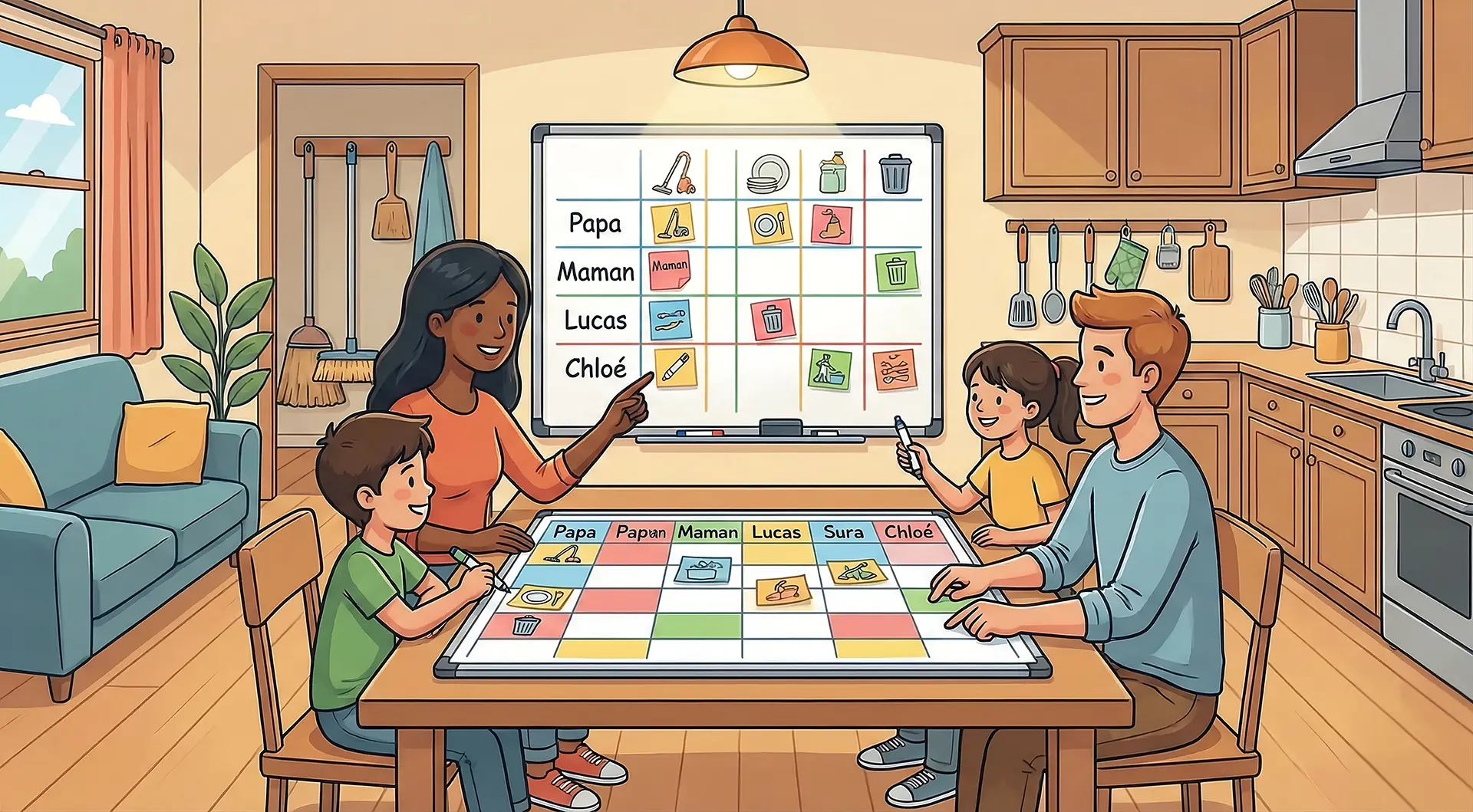
The Daily Challenge of Chore Distribution
In most households, the burden of household chores falls disproportionately on one family member, often the mother. Studies show that women spend an average of 3.5 hours per day on domestic tasks, compared to 2 hours for men. This silent inequality generates frustration, resentment, and tensions that can undermine family harmony over time.
The good news? With a structured approach and the right tools, it's entirely possible to establish fair distribution that satisfies all family members, including children.
Step 1: Create a Complete Task Inventory
Before dividing anything, you first need to visualize all the invisible work. Gather the whole family and list all household tasks together:
Daily Tasks
- Preparing meals (breakfast, lunch, dinner)
- Doing dishes or loading/unloading the dishwasher
- Clearing and cleaning the table
- Tidying common areas
- Taking out the trash
Weekly Tasks
- Vacuuming
- Mopping floors
- Doing laundry and hanging clothes
- Ironing
- Cleaning the bathroom
- Grocery shopping
Monthly or Occasional Tasks
- Deep cleaning
- Washing windows
- Organizing closets
- Garden maintenance
This exercise is often revealing: many tasks are done automatically by one person, without the rest of the family even being aware.
Step 2: Assign Points Based on Difficulty
Not all tasks are equal. Washing a few dishes isn't comparable to cleaning the entire bathroom. The point system objectively quantifies everyone's effort.
Here's an example scale:
- 5 points: Clearing the table, taking out trash
- 10 points: Doing dishes, tidying the living room
- 15 points: Vacuuming, doing a complete laundry load
- 20 points: Preparing a meal, cleaning the bathroom
- 30 points: Deep cleaning the kitchen, major cleaning
The Economic Balance of Points
Points should reflect the true perceived difficulty by your family. Observe behaviors:
- No one wants to do a task? Points are too low. Increase them! If "Cleaning toilets" at 10 points attracts no one, raise it to 20 or 25 points.
- Everyone fights over a task? Points are too high. Lower them! If "Watering plants" at 15 points causes disputes, reduce to 5 points.
It's supply and demand applied to chores. Natural balance occurs when points reflect the true perceived value of each task.
Step 3: The Debt/Credit System Explained
The fundamental principle is simple: the sum of all members' points always equals zero. When someone completes a task, they gain points, and other affected members lose them proportionally.
Concrete Example
Imagine a family of 4: Dad, Mom, Léa (14) and Tom (8). Dad prepares dinner (20 points).
If the whole family is affected:
- Dad gains: 20 - (20÷4) = +15 points
- Mom, Léa and Tom each lose: -5 points
- Total: +15 - 5 - 5 - 5 = 0 ✓
Step 4: Adapt Affected Members
This is where the system becomes truly intelligent. Not all tasks affect all family members the same way.
The Children Example
Tom, 8 years old, can't reasonably be held responsible for "Preparing dinner". This task doesn't affect him. However, "Clearing the table" affects him perfectly!
With FairChore, you can select affected members for each task:
- "Preparing dinner" → affects Dad, Mom and Léa (not Tom)
- "Clearing the table" → affects everyone, including Tom
- "Tidying Tom's room" → affects only Tom
Result: when Dad cooks, Tom doesn't lose points (he's not affected). But when Tom clears the table, he gains points and everyone (including his parents) loses some. Fair and motivating!
Automatic Memorization
No need to reselect members each time. FairChore automatically remembers your preferences: the next time Dad records "Preparing dinner", the right members will already be preselected.
Step 5: Involve Children According to Age
Children who participate in household chores develop autonomy, responsibility, and self-esteem. Here's how to involve them progressively:
- 3-5 years: Putting away toys, putting dirty clothes in the hamper
- 6-8 years: Setting and clearing the table, helping fold laundry
- 9-12 years: Vacuuming, loading the dishwasher, taking out trash
- Teenagers: Preparing simple meals, doing their laundry, cleaning the bathroom
With the point system, children see their contribution concretely and are motivated to participate more.
Benefits of Fair Distribution
- Fewer tensions: No more blame and silent resentment
- Shared mental load: Everyone knows what they need to do
- Responsible children: They learn community living
- Free time for all: More quality family time
- Egalitarian model: You pass on values of equity to your children
Conclusion: Take Action
Fair distribution of household chores isn't an unattainable ideal. With a clear method and a suitable tool like FairChore, every family can transform this source of conflict into a collaboration opportunity.
Start today: create your family group, invite all members, and let the point system do its work. Within a few weeks, you'll notice a significant improvement in family harmony.