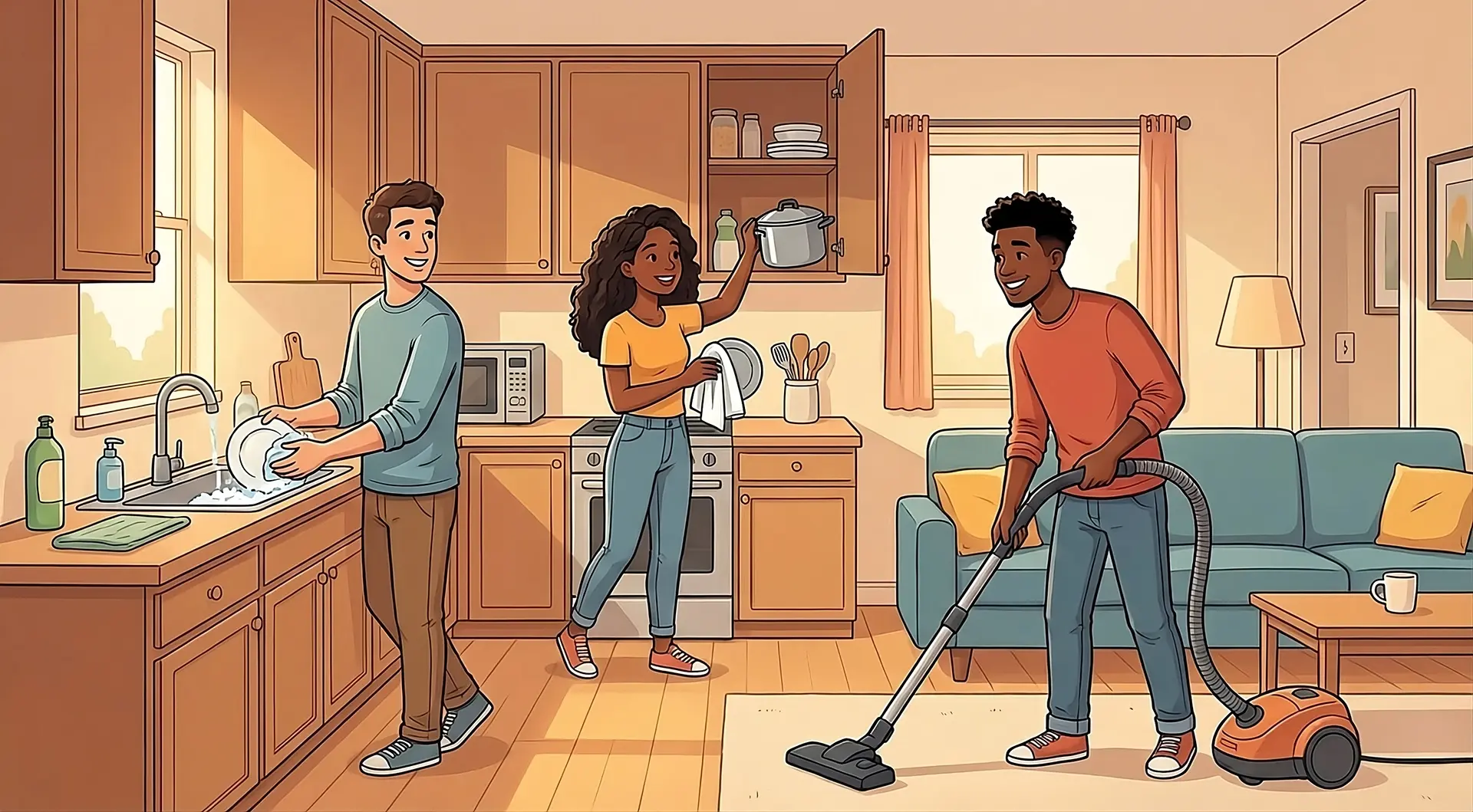
Household chores, a friction point in shared housing
Dishes piling up in the sink. Overflowing trash cans. The bathroom never cleaned. If you've lived with roommates, you know these situations.
The problem? Everyone has their own definition of "clean" and their own tolerance for mess. Without an objective system, resentment builds up and the atmosphere deteriorates. Fortunately, there are solutions.
Why traditional systems fail
The rotating schedule
"This week, it's your turn for the kitchen." Simple in theory, but:
- What if someone is away all week?
- How do you handle tasks of varying difficulty?
- No way to make up for a missed turn
Fixed assignment
"You do the kitchen, I do the bathroom." Problems:
- Some tasks are more unpleasant than others
- No flexibility if situations change
- Feeling of unfairness if workloads are unequal
The "everyone does it when they can" approach
Spoiler: it never works. Some people do everything, others nothing, and tensions explode.
FairChore puts this idea to work every day: every task is worth points, and the household total always stays at zero. That's why it's meant for more than one person: create the household, then send the invitation link to the people you live with. Free, ad-free, nothing to install.
Create our household for freeThe solution: the debt/credit system
FairChore offers a radically different approach based on a simple mathematical principle: the sum of all roommates' points always equals zero.
How does it work?
Let's imagine a 3-person shared apartment: Alex, Sam and Jordan.
Alex does the dishes (10 points):
- Alex gains: 10 - (10÷3) = +6.67 points
- Sam loses: -3.33 points
- Jordan loses: -3.33 points
- Total: +6.67 - 3.33 - 3.33 = 0 ✓
The person who does the work gains points. Those who benefit without contributing accumulate a "debt".
Complete transparency
No more pointless discussions like "I always do everything". The dashboard objectively shows who contributes and how much. Negative points speak for themselves.
Affected members: managing special cases
Not all roommates are affected by all tasks. FairChore allows you to select the affected members for each task.
Concrete examples
- Clean the living room: Affects everyone (shared space)
- Clean their private bathroom: Only affects the person who uses it
- Take out the kitchen trash: Affects those who cook at home
- Water Sam's plants: Only affects Sam
If Jordan never eats at home (he's traveling), he's not affected by "Do the dishes". When Alex or Sam washes up, Jordan doesn't lose points. That's fair!
Automatic memory
No need to reconfigure each time. FairChore remembers your preferences: the next time you log "Take out the trash", the right roommates will already be selected.
Adjusting points: economic balance
The number of points for each task must reflect its true difficulty. Observe behaviors:
Nobody wants to clean the toilet?
At 10 points, no takers? Raise it to 25 points. Someone will eventually find it "worth it".
Everyone wants to water the plants?
If this easy task at 15 points creates disputes, lower it to 5 points. The enthusiasm will calm down.
Tip: the debt rule
If nobody wants to do a task despite high points, it's up to the person with the lowest points to do it. Logic: the one with the most "debt" must contribute to rebalance.
Establish rules from the start
For harmonious shared housing, define the rules together from the beginning:
- List all shared tasks: kitchen, bathroom, living room, trash, shared groceries...
- Assign points: Discuss together the value of each task
- Define affected members: Who uses what?
- Create the FairChore group: One roommate creates the group and invites the others
Managing delicate situations
A roommate never does anything
Their negative points prove it objectively. Show them the dashboard. It's a fact, not an accusation.
Someone contests the difficulty of a task
Adjust the points together. If Jordan thinks "Vacuuming" isn't worth 15 points, vote to find a consensus.
A roommate is often away
Use affected members. If they're not there, they're not affected by the daily tasks during that period.
A new roommate arrives
Invite them to the FairChore group. They start at zero and begin contributing.
Benefits for your shared housing
- No more blame: Numbers talk, not emotions
- Flexibility: Not there this week? You catch up next week
- Motivation: Nobody wants to be the one with the most debt
- Preserved atmosphere: Less tension, more harmony
Conclusion
Household chores shouldn't ruin your shared housing experience. With FairChore, the question “am I doing more than my share?” gets a number for an answer, one everyone can check.
Create your roommate group today and discover the peace of mind of fair task distribution.