How to get kids to do chores without nagging: the short answer
Stop the one-off reminders and change the way your home is organized. In practice: make what the whole family does visible, parents included; give each child whole tasks of their own rather than asking for a hand here and there; and with your teen, negotiate the way adults who share a home would.
If you’re reading this, you probably know the scene: you repeat the same instructions, you end up doing it for them, and you feel like the only person in the house who sees what needs doing. It isn’t a lack of authority, or a question of personality: it’s the way the household is organized that makes you the only one responsible. The method below adapts to each age, from young children to grown kids who still live with you.
- Under 10: tasks of their own, and visible.
- Teens: fairness rather than obedience.
- Grown kids: the roommate rule.
- Everyone: a tally that shows the whole family, parents included.
Why nagging doesn’t work
Every “Can you empty the dishwasher?” makes you the household’s project manager. You’re the one who notices, the one who decides, the one who asks, and then the one who checks. Your child has only one thing to do: wait to be asked. And if they wait long enough, someone else often ends up doing it.
- One-off instructions leave all the thinking to the parent. The child does what they’re told, but carries nothing: neither the task itself nor the responsibility for making sure it gets done.
- Repetition wears down the relationship. By the third request, voices rise, and the argument is about the tone rather than the task.
- Doing it for them confirms the unspoken rule: this job isn’t theirs, since someone else always takes care of it.
So the problem isn’t only that your kids “won’t do anything.” It’s that nothing in the way your home is organized actually puts them in charge of anything. The sections below change that, age by age.
FairChore puts this idea to work every day: every task is worth points, and the household total always stays at zero. That's why it's meant for more than one person: create the household, then send the invitation link to the people you live with. Free, ad-free, nothing to install.
Create our household for freeUnder 10: tasks of their own, and visible
A task that belongs to your child is easier to keep track of, for them and for you, than a favor asked in passing. Instead of calling them over to “help,” give them one or two tasks from start to finish: they’re the one who feeds the cat, who sets the table for dinner, who puts their shoes away when they get home.
- Just one or two tasks, always the same ones for a few weeks, long enough for them to become a habit.
- Whole tasks, with a clear beginning and end: “set the table,” not “help me out a little.”
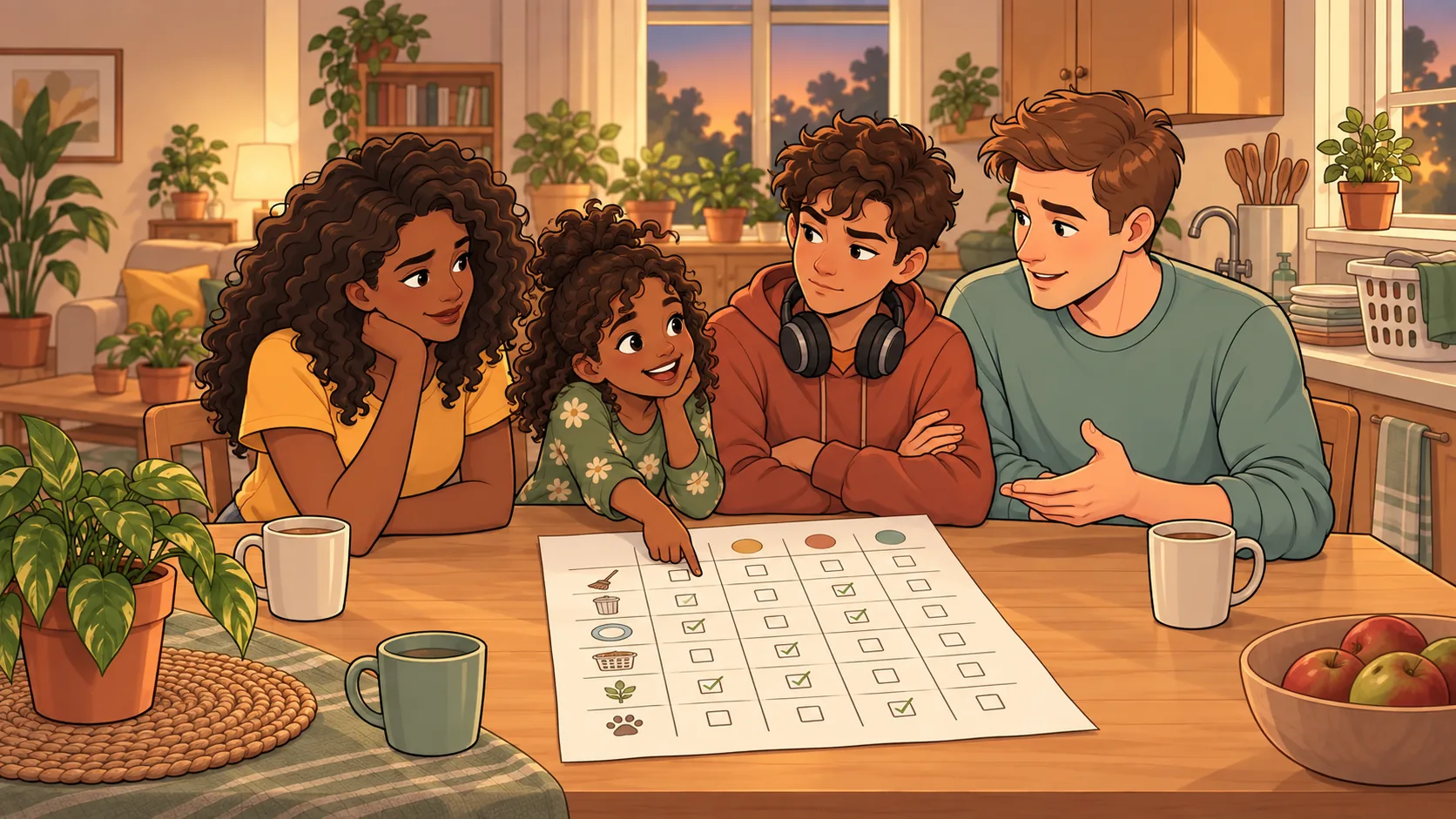
- A chart they can see, at their eye level, where you mark what’s been done. For a child who can’t read yet, pictures are enough.
- A result accepted as it is. A table set a little crooked is still a set table. Redoing it after them mostly teaches them that their work doesn’t count.
Which chores at which age? The detailed list, age group by age group, is in our guide to involving children in household chores by age. Here, what matters is something else: that the task is theirs, and that the whole family can see it’s been done.
Teen won’t do anything around the house? How to get teens to do chores
With a teenager, things change. They know how: they’ve emptied the dishwasher dozens of times. They don’t want to, they put it off, or they do the job so badly that nobody asks them again. The instructions that worked when they were eight no longer work, because they no longer accept being told what to do just because you’re the parent.
So change your argument: talk about fairness rather than obedience. “Everyone lives here, so everyone pitches in” has one advantage over “Do it because I said so”: the rule applies to everyone, parents included, and a teen can hardly challenge it without challenging their own place in the home.
- Let them choose their tasks. From the list of what needs doing, they take their share, but they get to pick which part.
- Let them choose when. “The trash is out before pickup” rather than “Take out the trash now.” The deadline matters, not the time of day.
- Agree on a minimum, then accept their way of doing it. Decide together what “done” means. Above that minimum, don’t comment.
- Talk about the rule, not about them. “In our house, everyone does their share” targets the rule; “You never do anything” targets the person, and invites them to get defensive.
Finally, give them the same view you’d give an adult. A teen who can see what everyone does, their parents included, has less reason to think they’re being asked to do more than anyone else.
Grown kids who still live at home
When your child is eighteen, twenty, or twenty-five and still lives with their parents, the word “help” becomes misleading. They aren’t helping: they live there. The simplest rule is the one that applies between roommates: a share of the chores that matches their place in the home.
- Their own things and their room, entirely their responsibility: that’s the bare minimum for any roommate.
- A share of the common chores: cooking, grocery shopping, household laundry, trash, bathroom.
- A share adjusted to their situation: a student during finals or a young adult working odd hours can take on different tasks, but can’t skip chores altogether.
Set this rule the way you would with a roommate: once, calmly, starting from the list of what needs doing, then with a regular check-in to adjust it. It’s no longer a parent asking a child: it’s an agreement between adults who share a home.
Make what everyone does visible, parents included
This is the point everything else depends on. A child who sees only their own chores on a chart experiences it as a punishment: there’s a list, and it’s for them. A tally that also shows the parents’ tasks becomes a shared rule: everyone is on it, everyone contributes, and everyone sees what the others do.
This is what FairChore makes possible. When someone does a task, its value is shared among the people concerned: whoever did it earns points, and the others concerned owe their share. The household total stays at zero. Each person’s balance accumulates from the first day: it is never reset to zero.
Each family member joins in their own way:
- The other parent and your teen. To bring the other parent or a teen into the household, FairChore gives you an invitation link to send them. According to FairChore’s Terms of Service, a teen can have their own account from age 13, with a parent’s consent if they are under 16; they then join the household through the invitation link.
- The youngest. For a child too young to have their own account, the parent who manages the household creates a supervised account: the child does not log in themselves. The parent who created the supervised account can switch to the child’s profile, so that it’s the child who logs what they’ve done.
One point is worth stressing: the whole household needs to be on it, or the balance tells you nothing. If only the children log what they do, you’re back to the chore chart that feels like a punishment. If the parents log what they do as well, the balance becomes what it should be: a shared measure that nobody holds against anybody.
Should you reward chores?
It’s a question many parents ask: should you pay kids for chores, or tie chores to their allowance? There’s no single answer, and families come down on different sides.
- For: a concrete reward can help get a habit started, and it links work to value.
- Against: if every chore is paid, an unpaid chore becomes one you can refuse, and taking part in household life becomes optional.
- In between: some families keep the two separate, with basic chores everyone does because they live there, and extra, optional chores that can earn them something.
Whatever you choose, decide in advance and write it down, so the rule doesn’t get renegotiated every time you ask. If allowance is the question on your mind, another article on this blog is devoted to it.
What doesn’t work
Some reactions are understandable when you’re tired of repeating yourself. Yet they keep alive the very problem they’re meant to solve.
- Doing it for them with a sigh. The task gets done, the sigh is heard, and what the child mostly takes away is that someone else always ends up taking care of it.
- Punishment without a written rule. Punishing a child for a task that was never clearly assigned to them feels unfair, and the child argues about the punishment instead of the task.
- Changing the rules every week. A system that shifts with your mood or how tired you are can’t be learned. A modest rule you stick to beats an ambitious one dropped after ten days.
Instead, keep three simple things in mind: tasks assigned once and for all, a written rule that’s the same for everyone, and a tally the whole family can see. Start small, with one task per child and a weekly check-in, then adjust from there.